
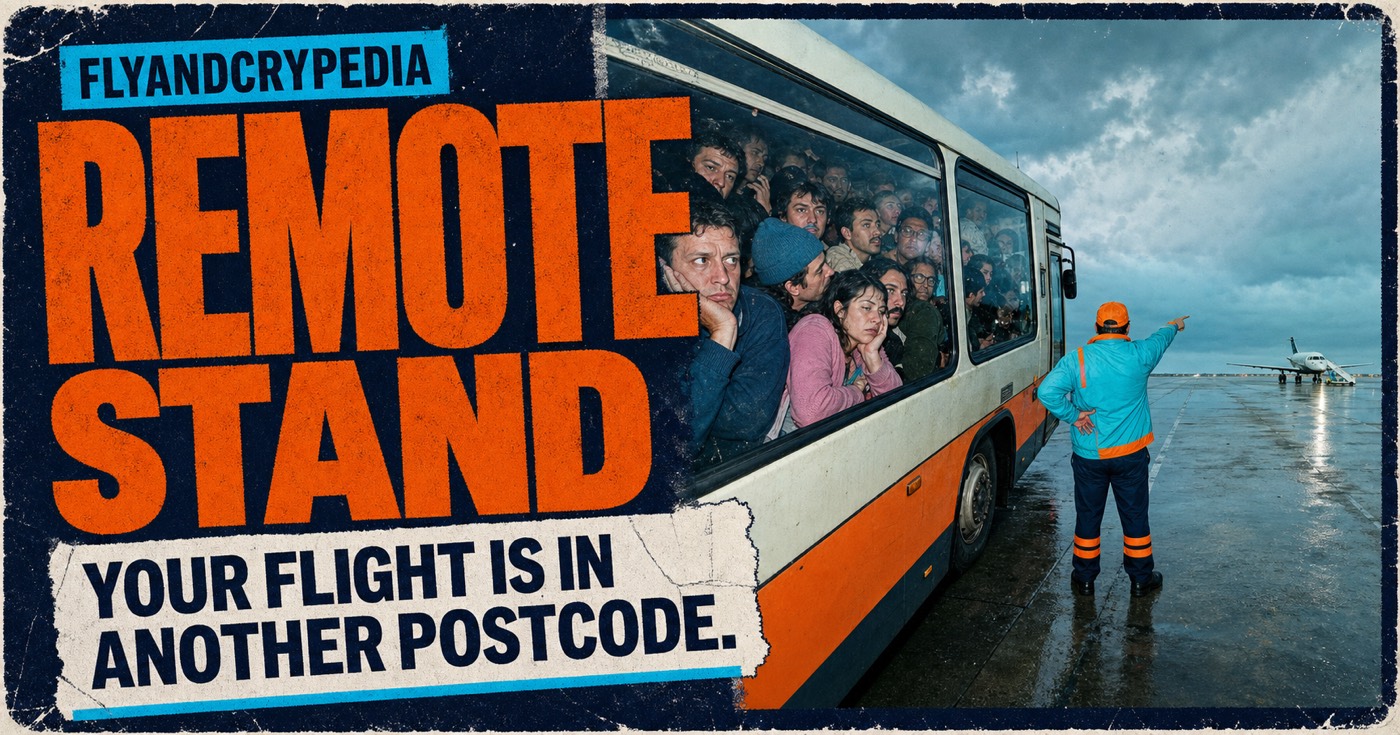
A remote stand is an aircraft parking position away from a terminal’s contact gate, so the aircraft is not directly connected to the building by a passenger boarding bridge. Passengers are commonly transferred between the terminal and aircraft by bus, or sometimes walk under airport supervision, then board or leave using mobile stairs.
The FlyAndCry definition
Your flight is parked in another postcode.
A remote stand turns boarding into ground transport with an aircraft at the end. The terminal has already taken several kilometres of walking from you, but the airline has found an exciting outdoor extension.
Why do airports use remote stands?
Airports have a limited number of contact gates with boarding bridges. Remote stands let more aircraft park and operate when those gates are unavailable, unsuitable or better allocated elsewhere. They can also be used during long turnarounds so an aircraft does not occupy a contact stand needed by another flight.
How boarding works
Passengers usually wait at a bus gate, have their boarding passes checked and travel across the apron in an airport bus. At the aircraft they follow staff directions and use stairs. Arriving passengers make the trip in reverse. The transfer adds time, so remote-stand boarding may begin earlier than boarding through a bridge.
At FlyAndCry
FlyAndCry calls this our Panoramic Apron Experience:
- the bus departs when it contains more passengers than oxygen;
- your aircraft is the fourth identical aircraft after the one you hoped was yours;
- the scenic route includes every service road currently available;
- Priority Boarding guarantees first access to the staircase queue.
A small Outdoor Terminal Discovery Fee may appear because the terminal was technically discovered outdoors. Weather is complimentary and cannot be declined.
See also
Passenger Boarding Bridge, Gate, Boarding Group, Final Call, Connection, Airport Transfer.
Factual background
EUROCONTROL’s landside-modelling work distinguishes contact stands, where passengers use a boarding bridge, from remote stands, where passengers leave a gate lounge, take a bus to the aircraft and use a separate bus-arrival process on return. It also notes that the bus transfer takes additional time.
EUROCONTROL: CDM Landside Modelling, Project Phase 2 — checked 13 July 2026.